
This post was originally published by IronSpark CEO Lisa Damast on her LinkedIn account and will be included in IronSpark’s newsletter, Signals, this week. It has been slightly modified here for a blog post (mostly the addition of hyperlinks and subheads).
The Economist published an interesting article last month about AI adoption and lessons learned so far.
Where AI Is Actually Working: Customer Service and Coding
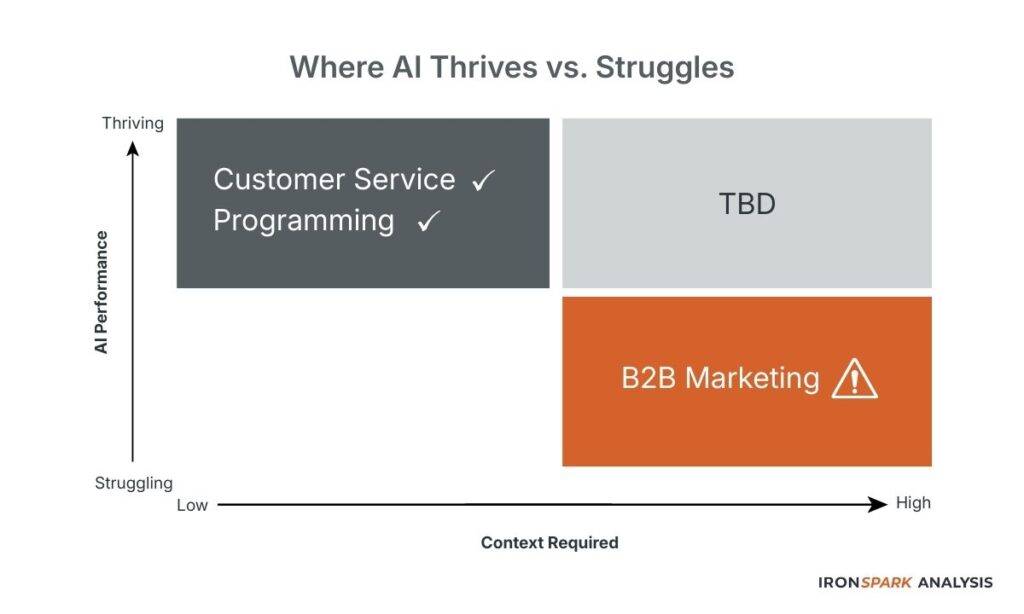
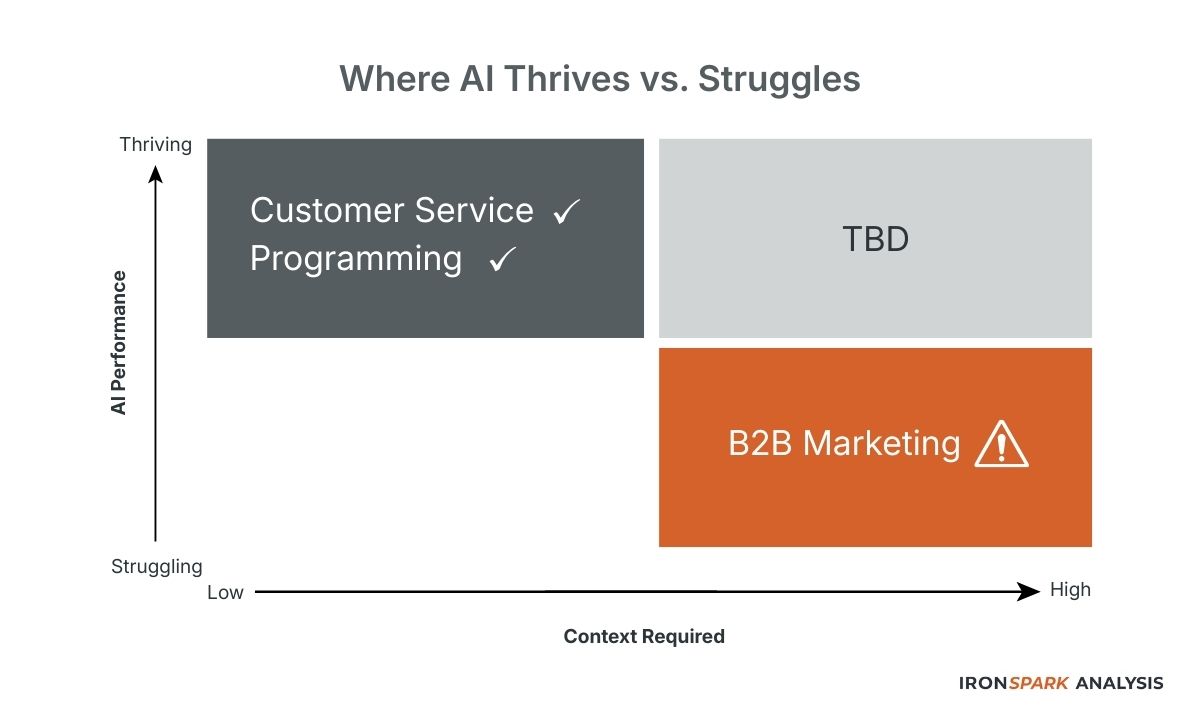
AI is thriving in customer service and programming for two main reasons, according to The Economist article:
- “The tasks performed by coders and call-center agents tend to be ‘context-light,’ meaning those who do them don’t need a deep understanding of the company.
- The abundance of available data that can be used to train models.”
Consumer Marketing vs. B2B: The Context Problem
The article didn’t discuss marketing but it’s reasonable to assume there’s enough material out there for decent content for marketing consumer goods too, given the broader audience and that it has more of a variety of sources compared to B2B. It also plays more to emotions.
Right?
Not exactly. Consumer marketing has been changing when it comes to large or important decisions such as buying a car, finance, health, and more. What hasn’t changed is that those decisions are still fast compared to B2B.
Why B2B Marketing Is Context-Heavy (Not Context-Light)
In B2B, context is key across all industries and there isn’t enough material out there to make it meaningful. Especially with the growing focus on personalization and account-based marketing and the ever-larger buying committees and lengthy sales process.
The Trust Gap: What B2B Marketers Really Think About AI
The trust gap isn’t stopping marketers from trying though. Content Marketing Institute’s (CMI) 2025 annual survey found that 45% of respondents planned to increase their investment in AI-powered marketing tools, including generative AI.
That’s despite persistent quality concerns. CMI’s 2024 research revealed:
- Only 4% of B2B marketers reported a high level of trust in generative AI’s outputs (67% said medium trust)
- Only 17% of B2B marketers say AI-generated content is excellent or very good
- And 10% cite poor content quality as a key challenge
While the 2025 survey shows some marketers are seeing improvements with AI tools, our experience working with data and analytics vendors suggests the context problem remains, especially in highly technical markets.
Domain Expertise vs. AI: What Data Leaders Actually Want
Why do these stats matter?
Because buyers increasingly want content that’s context-heavy, content that demonstrates you understand their specific challenges. Domain expertise has never been more critical.
Yet marketers are betting on a technology they don’t trust to deliver that depth. Maybe because the pressure to adopt AI is outpacing what it can actually do for complex B2B marketing.
Which is why generative AI in marketing isn’t thriving yet.
What’s your take? Are you seeing it thrive in your organization?
AI disclosure: AI was used to create the headline and subheads in this post.