
This blog post was originally published by Elisabeth Strenger, IronSpark’s Open Source and Responsible AI Analyst, as a LinkedIn article.
It’s that time of year again. When two of the most competitive data platform vendors step back in the ring. I’m referring, of course, to the back-to-back conferences of Snowflake and Databricks, both held in San Francisco’s Moscone Center, June 1-4 and June 15-18, respectively. While the direct competition is subtle, users of such platforms view it like a boxing match of Rock ‘Em Sock ‘Em Robots, a classic two-player mechanical boxing game originally released in 1964. Users and industry observers used to watch the match for indicators of which platform or approach they should choose. Now, however, the market has spoken, and there’s a consensus among analysts and consultants that many, many enterprises use both Snowflake and Databricks. In fact, some will tell you that they don’t encounter any company that only uses one.
This leads me to believe that the enterprise data landscape has become so complex that no single platform can cover all of it. One reason for this complexity is that we do more with data than ever before. For years, pundits have been telling business leaders that their data is their most important asset. Now, leaders are realizing that infusing their analytics, operations, and customer experience with data indeed allows them to differentiate themselves from their competition. Data now serves multiple purposes in an organization. These various uses have distinct processing workflows. AI has allowed us to finally use images, videos, voice, email, documents, and even notes from meetings, calling for even greater processing power and tools. Additionally, there’s the time dimension–data is collected in real time, yet some data must be stored for years. All of it must be safeguarded as tightly as we once only did networks. And then there are the data-intensive applications and AI agents, all needing some degree of interoperability and integration. I am sure that there are complications that I haven’t listed here. I suppose I could ask an LLM for more, but you get the picture.
Getting back to Snowbricks and Dataflakes – um, Snowflake and Databricks – their relationship seems less like a boxing match and more like a tempest in a teapot that has outgrown the teapot., If we go back to the original releases of both Databricks and Snowflake data platforms, each was narrowly spec’d as an analytic data platform, not a general-use database platform. Specifically, Snowflake was designed for business reporting and decision-making, whereas Databricks provided data for advanced forms of analytics, from ad hoc data discovery to statistics and artificial intelligence (AI). Snowflake’s primary data product was the relational and dimensional data warehouse, whereas Databricks’ was the data format-agnostic data lake, stretched into a lakehouse.”
So, the two vendor firms seem like competitors because each offers an analytics data platform. But the truth is that the thoughtful differentiations of their original releases make their offerings complementary. After all, the range of requirements for a modern, twenty-first-century data architecture includes specific best-of-breed solutions for both traditional business tracking and decision making (based on carefully selected and curated data in a warehouse) and emerging data discovery and automated actions (based on broadly and massively collected raw data in a lake). This is why many user firms with diverse analytic requirements have decided to deploy both Snowflake and Databricks, side by side – or cloud by cloud – in a multi-platform data architecture that is integrated by shared data, semantics, and end users.
Now, imagine a platform that can handle all of it. Perhaps you are onto a future product. And this is the product strategy that has guided both Databricks and Snowflake. Distinguished data management analyst (IronSpark Analysis) Philip Russom, Ph.D. observes:
One way to think of it is that each started at an opposite end of the modern lakehouse concept, then evolved to look more like the other. For example, Snowflake started exclusively as a data warehouse platform, but has evolved into a more diverse lake that can support advanced analytics (as seen in the lengthening list of data formats supported by Snowflake Cloud’s storage, both internally and externally). Conversely, Databricks started as a data platform for advanced analytics, but has evolved recently to include data warehousing functions (especially in the set of services called Databricks SQL).
Hence, Databricks and Snowflake have evolved to overlap with each other, to be more competitive in customer wins. But what’s next, once each has reached the other end of the lakehouse?
Currently, enterprises build stacks with components specialized for different parts of data utilization. Stacks, plural, because indeed there are multiple stacks composed and configured for specific processes. The AI stack, for example, might be too expensive for doing general analytics, etc. But data platforms such as Databricks and Snowflake simplify our interactions with data. They build and maintain sets of specialty stacks in the cloud for customers. They determine which hardware is required by a workload. Of course, users can make their own decisions, but unless you have experts in the capacity of various GPUs and CPU architectures, relying on the vendors’ expertise is a wise call.
The Competition
Suppose they had a war and nobody came? Even techies love drama, and the Snowflake vs. Databricks battle for the market share and mindshare of analytic data platforms has certainly delivered. However, in the eyes of customers, there is no toe-to-toe battle. Certainly, they can compare features, boast about speed to market, and the size of their customer base or partner ecosystem. These are important when making buying decisions and vendor commitments. These criteria take on a different weight when measured against operational needs and business strategy. Data and IT teams realize that they are best served by two platforms.
Now, Databricks and Snowflake’s positions within a multi-platform data architecture differ, depending on the data flow or usage within a specific data process or pipeline. Sometimes data is ingested first into Snowflake and then passed to Databricks. Or vice versa. And some data streams or sets might follow a different path from other data. It all depends on what the organization needs to do with data. One simple way to think of the two platforms is that Databricks is often used as a Data Lake that does a very good job of accommodating all types of data and ingestion speeds. After data lands in the Data Lake, data teams then curate the data and send it along to the Snowflake Data Lakehouse from where it feeds applications.
These applications now include AI agents, driving up the demand for managing more data more quickly. 23% of companies are already using agentic AI at least moderately and is projected to reach 74% within two years, according to Deloitte.
Although there probably won’t be direct critiques aimed at the other data giant, one-upmanship will be on full display: whose customers are more satisfied, which is more cost-effective, who cares more about security, and as always, speeds and feeds and scalability will count.
The most important contest will be played out for dominance in agentic AI. Agentic AI is a common thread across many of the sessions on both agendas. Interesting to note is that the adoption of agentic AI has been so rapid that the conferences seem to be skipping a step. Last year’s conferences were looking at AI agents as being on the horizon with early adopters experimenting and offering some training on the basics. This year, the talks assume familiarity with agents and dive into specific usage examples, operational tactics and “advanced” scenarios like multiple agents working in parallel and, even more difficult, co-executing with agents beyond the firewall. Even the use of third-party agents, like Salesforce Agent Force, seems to be a given. See The Agendas section below.
The Victors
The next step for these platforms is to transcend the limits of the analytic data platform (sometimes called online analytic processing or OLAP) by supporting database functions for transaction processing (sometimes called online transaction processing or OLTP), which they seem well on their way to doing which will gain them entry to the far larger market of general-purpose database management systems (DBMS). However, the competitive challenge there will be to compete with traditional OLTP and DBMS stalwarts, namely Oracle and IBM, plus well-established hyperscalers like Amazon Web Services and Amazon Azure.
More interesting to those of us watching the shift in the overall data landscape is how agentic AI is influencing the future of data. The question of the day is, which of our two ascendant platforms will be ahead in the agentic arena? In which aspect of agentic AI will one dominate?
It might not matter in the long run, because customers will benefit from having a rich set of features supporting AI agents from both Databricks and Snowflake. Enterprises have decided that it’s not strictly an either/or choice between the two data platforms. Many customers use both, typically choosing Databricks for ingesting very large amounts of data at very high speeds into the data lake and “curating” it before sending it to a Snowflake lakehouse from where it feeds the organizations’ workloads and applications.
Who is the victor, then? I call victory for the customers.
The Agendas
Comparing the Snowflake (June 1-4 Moscone Center, San Fran.) and Databricks (June 15-18 Moscone Center, San Fran.) agendas shows a great deal of overlap between the two conferences. Take a look at how the two companies use similar themes to organize their program (see the following table).
Both events have many sessions where customers will share lessons learned, best practices, team organization, and working across their organizations to get stakeholder buy-in and executive approval.
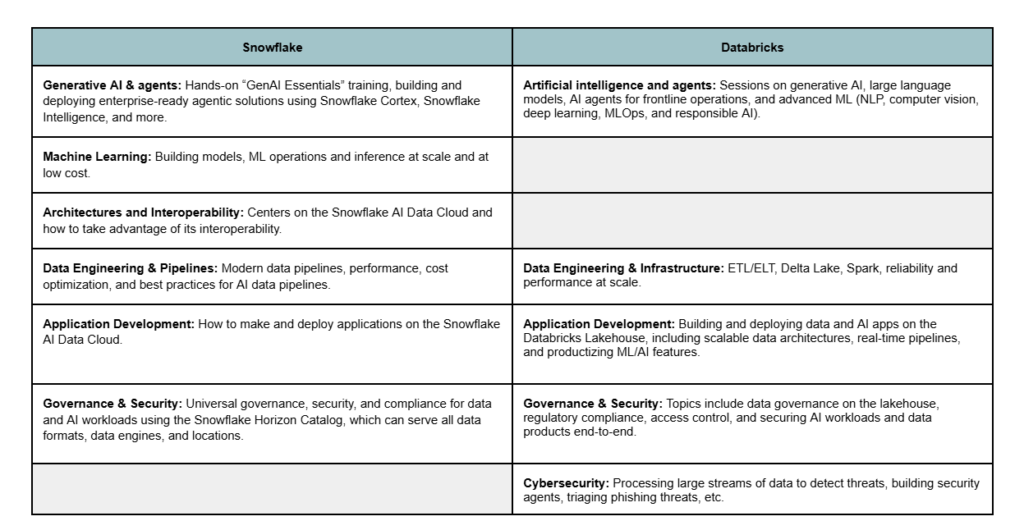

Snowflake’s agenda includes tracks for migration and modernization, data sharing and the marketplace, industry-specific solutions and performance / cost optimization.
In addition to agenda tracks, Databricks’ sessions emphasize open source with deep dives into Delta Lake and Apache Spark, and on using the data lakehouse for data storage and access, AI and analytics.
Note: I used Perplexity as my research assistant.

Elisabeth Strenger
Open Source and Responsible AI Analyst, IronSpark Analysis
Elisabeth Strenger is an analyst at IronSpark Analysis, covering open source technology and responsible AI. This piece was originally published as a LinkedIn article, offering her analysis of the Snowflake and Databricks 2026 conferences alongside insight from fellow IronSpark analyst Philip Russom. Connect on LinkedIn →