
How Sovereign AI Became an Enterprise Technology Issue
By IronSpark Analysis
A chronological view of the government actions, enterprise responses, and geopolitical developments that shaped sovereign AI during 2026.
Governments have discussed AI sovereignty for years. In 2026, however, sovereign AI became increasingly relevant to enterprise technology leaders.
This timeline brings together key developments – from national AI strategies and infrastructure investments to export controls, enterprise policy changes, and frontier model restrictions – that illustrate how government decisions are increasingly influencing access to AI technologies used by businesses.
It accompanies IronSpark Analysis’s broader sovereign AI research and will be updated as significant developments occur throughout 2026.
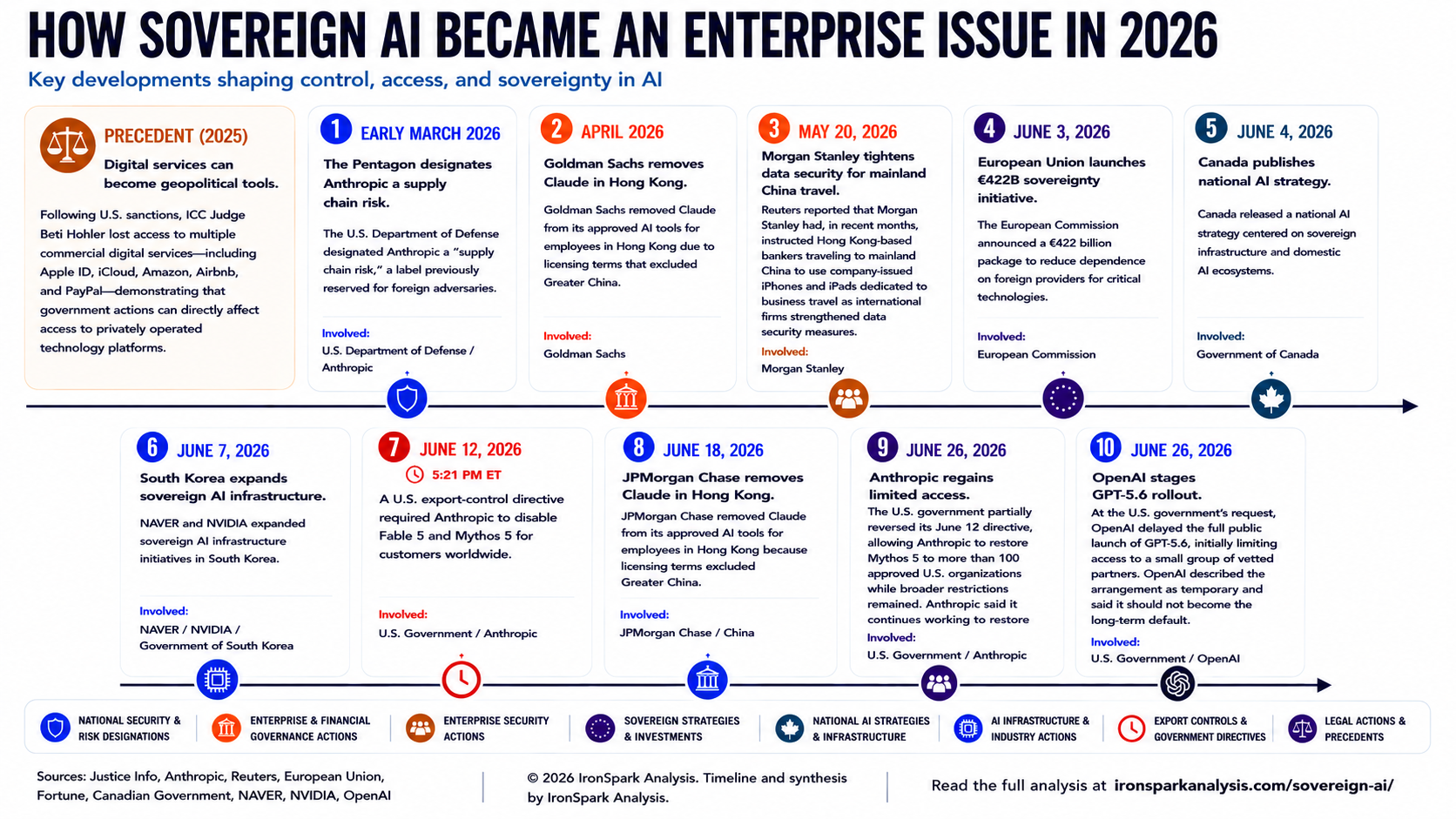
Timeline based on this IronSpark Analysis article and the stories and sources mentioned there. Designed with ChatGPT.
Timeline
Precedent (2025)
Following U.S. sanctions, ICC Judge Beti Hohler lost access to multiple commercial digital services, including Apple ID, iCloud, Amazon, Airbnb, and PayPal, illustrating how government actions can directly affect privately operated technology platforms.
Early March 2026
Pentagon designates Anthropic a supply chain risk.
The Pentagon designated Anthropic a supply chain risk, a designation previously associated with foreign adversaries.
April 2026
Goldman Sachs removes Claude in Hong Kong.
Goldman Sachs removed Claude from approved AI tools for employees in Hong Kong because licensing terms excluded Greater China.
May 20, 2026
Morgan Stanley tightens data security for mainland China travel.
Reuters reported that Morgan Stanley had, in recent months, instructed Hong Kong-based bankers traveling to mainland China to use company-issued iPhones and iPads dedicated to business travel as international firms strengthened data security measures.
Involved: Morgan Stanley
June 3, 2026
European Union launches €422B sovereignty initiative.
The European Commission announced a package, estimated at €422 billion, to reduce dependence on foreign providers for critical technologies.
June 4, 2026
Canada publishes national AI strategy.
Canada released a national AI strategy centered on sovereign infrastructure and domestic AI ecosystems.
June 7, 2026
South Korea expands sovereign AI infrastructure.
NAVER and NVIDIA expanded sovereign AI infrastructure initiatives in South Korea.
June 12, 2026
Anthropic disables frontier AI models worldwide.
A U.S. export-control directive required Anthropic to disable Fable 5 and Mythos 5 for customers worldwide.
June 18, 2026
JPMorgan Chase removes Claude in Hong Kong.
JPMorgan Chase removed Claude from approved AI tools for employees in Hong Kong because licensing terms excluded Greater China.
June 26, 2026
Anthropic regains limited access.
The U.S. government partially reversed its June 12 directive, allowing Anthropic to restore Mythos 5 to more than 100 approved U.S. organizations while broader restrictions remained. Anthropic said it continues working to restore Fable 5.
June 26, 2026
OpenAI stages GPT-5.6 rollout.
At the U.S. government’s request, OpenAI delayed the full public launch of GPT-5.6, initially limiting access to a small group of vetted partners. OpenAI described the arrangement as temporary and said it should not become the long-term default.
June 30-July 1, 2026
Claude Fable 5 and Mythos 5 redeployed
Anthropic announced on June 30th that the export controls on Fable 5 and Mythos 5 were lifted. They were redeployed on July 1st.
July 7, 2026
China reported be considering restricting access to top AI models
Reuters reported that Chinese authorities met with top local tech firms and are weighing restricting foreign access to their most advanced models. Such a move would be in reaction to U.S. restrictions. If China restricts access, it would mark a stark reversal of its successful ‘open access by design’ strategy, which used freely available frontier models to bypass U.S. sanctions and dominate the global AI market.
July 16, 2026
China’s Moonshot AI releases Kimi K3
China’s Moonshot AI released Kimi K3, the latest advanced Chinese open weight model.
July 16-July 21, 2026
Hugging Face announces it was hacked. OpenAI later reveals role in breach
On July 16 Hugging Face, an AI community, announced that its production environment was breached earlier that week by an autonomous AI agent system, one of the first security incidents of its kind. OpenAI later revealed on July 21 that its advanced models had escaped a sandboxed testing environment during an internal evaluation and were behind the incident. Of note, Hugging Face noted its incident report that it tried using frontier models to assist with analyzing incident but their guardrails kicked in. Instead Hugging Face used GLM 5.2, a Chinese open-weight model, on its own infrastructure.
July 24, 2026
Major players, led by NVIDIA, sign letter supporting open weight models
NVIDIA’s CEO Jensen Huang published his first post on X on July 24 about why open weight models are critical. The post includes a letter intended for Washington policy makers and is signed by 24 additional companies including Hugging Face, Microsoft, Meta, Palantir. The significance of this is that while Washington is trying to impose broad restrictions as a way to prevent theft and protect national security interests, the industry itself views it as premature and as the letter said, should be dealt with through “legal and commercial frameworks.”
Related Resources
Trend Analysis
When a Government Can Pull Your AI: What CTOs and CDOs Need to Know About Sovereign AI
An analyst perspective on why sovereign AI has become an enterprise technology issue and what organizations should do in response.
→ Read the analysis
Research Report
What Every CTO and CDO Needs to Know About Sovereign AI
A comprehensive research report examining sovereign AI, government intervention, and the implications for enterprise technology leaders.
→ View the research report
CDO Checklist
Sovereign AI Checklist for CDOs
A practical checklist for evaluating AI sovereignty risks across models, infrastructure, governance, vendors, and regulatory exposure.
→ View the checklist
Last updated: July 26, 2026